Temporary Website for the first 2 weeks of ENGL 330 98a: The Linguistic Structure of Modern English
Information for Weeks 1 and 2 of English 330 98a, May 2026:
The course is going ahead and will take a different form for the first week or two while we wait for the problem with Canvas to be resolved. Please see the following concise introduction and syllabus. As we wait for Canvas, you may get started on the material for Module 1 of ENGL 330 98a, The Linguistic Structure of Modern English.
A full introduction to the course will follow once Canvas is open. In the meantime, please review the syllabus, complete the reading and exercises, and prepare your first, short, discussion post on something from the reading that you found surprising, interesting or complicated. Your post should be approx. 100-150 words. Once Canvas is up, you can post it to the first class Discussion by May 21st (worth 1%).
The following is a concise course description. The full syllabus and course schedule can be downloaded here:
ENGL 330 98A
Course Description
This course explores and examines contemporary English phonology, morphology and lexical semantics. It begins with the study of speech sounds in English. We apply methods for phonetic transcription and study distinct sounds and possible sound combinations in English (phonology). We study the processes of word formation and word classification in English (morphology). We also study word meaning (lexical semantics) using a variety of approaches.
Course Focus:
This is a fact-based course. The aim of the course is to teach a body of information and a mode of inquiry. Students will need to use their problem-solving skills and the course will also involve building skills in using and applying the techniques learned, based upon examples. Students have several resources to rely on: the instructor, the textbook and associated workbook of exercises, online discussion forums and group work, and their own understanding and consideration of the content and the text.
Course Objectives:
Upon completion of this course, students will have:
- a knowledge of the English sound system, including sounds that are used in speech production and their patterning in use
- an understanding of the rules of English word formation and grammatical modification
- a knowledge of different approaches to understanding lexical meaning
- an appreciation of the nuances of meaning in human language and an acquaintance with the conceptual system underlying meaning.
Course Evaluation:
There will be 5 quizzes of equal weight (25%), 3 group assignments (each worth 10%), a final assessment (40%,) and a class participation mark (5%) based on participation in 5/6 discussion forums. The quizzes are not cumulative, and students may have 2 attempts. The final assessment is cumulative and a passing grade of 50% is required.
Textbook and Workbook:
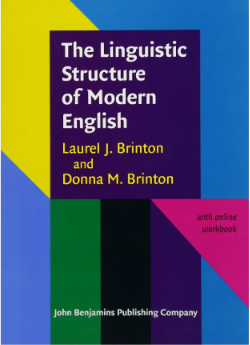
The required textbook is L.J. Brinton and D.M. Brinton’s The Linguistic Structure of Modern English (2010).
Registered students may access online version for free. Once Canvas is up and running you can click “Library Online Course Reserves” on the left column of the course page in Canvas. Once in the Library system, click the pdf to view a copy of the book online. You may need to register using your UBC cwl. In the meantime you can access the online version through the UBC library or access the pdf.
There is a workbook for this textbook. This is also accessible on our Canvas course page, but in the meantime, access it here:
Students are expected to make use of this workbook and complete all assigned self-directed exercises. Once we are on Canvas the textbook and workbook will be accessible via the Canvas course home page.
Scheduling
There is a weekly schedule of assignments and activities that you will access through Canvas. The earliest of these may be adjusted slightly due to the Canvas breach. The final schedule will be visible online once Canvas is back up and running. Once this happens, students should familiarize themselves with this schedule in the first days. Detailed descriptions and expectations for each of the required course components will be listed in the Assignments section in Canvas.
Full details of the expectations and timing for each of the class components will be included in the online schedule at the bottom of the full syllabus and on Canvas modules.
Group Assignments:
There are some scheduling requirements for participation in group assignments, with some timing to be determined by members of the group. Students will stay in the same group for the duration of the course.
Quizzes:
Quizzes and the final assessment will be open book. Quizzes will be open for a period of at least 2 days and students will have 2 attempts to write each quiz. Before the first graded quiz there is a practice quiz that students can complete to become familiar with the format.
Policies
English 330 98a covers the content of the UBC ELL Language Program’s required course on the Linguistic Structure of Modern English Sounds and Words, while providing the flexibility for students to work on their own schedules and from different time zones. The course is asynchronous and combines a mixture of readings, self-directed exercises, lectures, discussion contributions and collaborative group work. There are four-five optional Zoom sessions, one at the beginning of the course, one at the end, and two-three other lectures through the term, (depending on how soon Canvas is restored). Recorded slides and any additional content covered during the Zoom meetings will be posted on Canvas following the sessions. Using generative AI for assessments is not permitted.
The required components of the course follow:
- Five online quizzes worth 5% each (25%)
- Participation in 5/6 discussion forums worth 1% each, including posting at least one contribution and responding to one contribution. (5%)
- Three collaborative group assignments worth 10% each (30%)
- A final, timed assessment/exam (open book, 2.5 hours) to be completed on a scheduled day with a flexible starting time (40%).
Getting Started with MODULE One
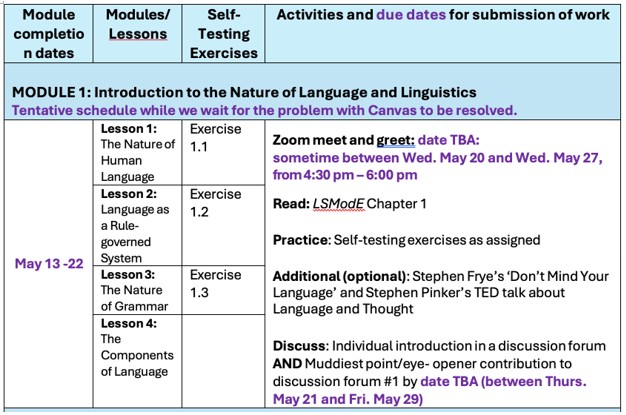
Our first course module will be Introduction to the Nature of Language and Linguistics. Here it is below, excerpted from the full syllabus. You’ll notice the dates for meeting and for posting your contributions to the discussion forum are flexible for now. I will email to update the class once a time for the first Zoom meeting is scheduled. Recorded slides for the introductory Zoom session will be posted for those who can’t attend.